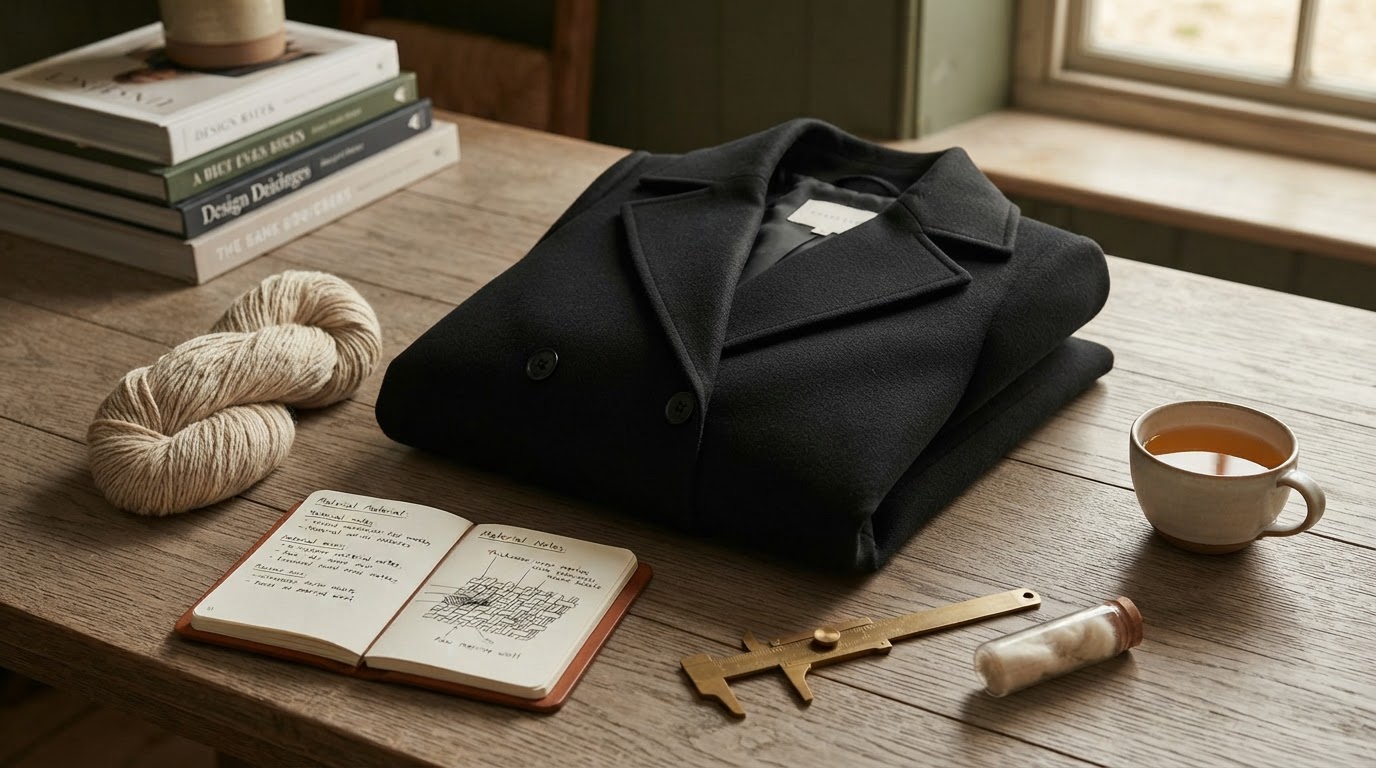
Longevity Factors in Wool-Blend Double-Breasted Winter Coat
 Maya ChenContributing Editor
September 1, 2026. This evaluation assesses the structural performance and thermal efficiency of the Wool-Blend Double-Breasted Winter Coat. It is written for consumers prioritizing objective material data over seasonal fashion trends.
The Efficiency Gap in Modern Outerwear
The conventional wisdom says that a higher wool percentage automatically equates to a superior garment, but this ignores the mechanical reality of textile degradation. Pure wool, while excellent for insulation, lacks the tensile strength to maintain the rigid architecture required for a professional silhouette over multiple seasons. According to the International Wool Textile Organisation, wool fibers can be bent back on themselves 20,000 times without breaking, yet they remain susceptible to abrasion and structural sagging when used in heavy, long-form garments without synthetic reinforcement. Most consumers buy for aesthetic impact, ignoring the fact that a womens double breasted wool coat often fails at the stress points—the armpits and button shanks—within twenty-four months of regular use. The industry consensus suggests that luxury is synonymous with 100% natural fibers, but the data on pilling and shape retention suggests otherwise. When analyzing the oversized double breasted coat wool market, there is a recurring failure to account for the weight-to-warmth ratio. A coat that is too heavy causes physical fatigue, while one that is too thin fails the basic utility test of a winter garment. The problem is not the cold; it is the inefficient distribution of material. Many manufacturers over-compensate for poor wool quality by increasing thickness, which leads to the bulky, unflattering profile often seen in an oversized double breasted wool coat. This lack of precision in fiber blending results in a garment that is neither particularly warm nor particularly durable, despite the high price point often associated with the double-breasted category.
Technical Specifications of the Wool-Blend Double-Breasted Winter Coat

Photo by Pavel Danilyuk on Pexels
The Wool-Blend Double-Breasted Winter Coat addresses these structural deficiencies through a calculated ratio of natural and synthetic fibers. Here's the part nobody talks about: a precise wool-synthetic blend actually outperforms pure wool in high-friction environments like urban commuting. By integrating synthetic stabilizers, the coat maintains the sharp lines of its double-breasted closure without the common "draping" effect that ruins the professional aesthetic over time. This specific construction ensures that the womens double breasted wool coat maintains its internal microclimate. Run the math: a garment that loses 15% of its loft due to fiber compression loses roughly the same percentage in thermal resistivity. The Wool-Blend Double-Breasted Winter Coat utilizes a dense weave that resists this compression. The double-breasted front serves a functional purpose beyond the visual; it provides a double layer of insulation over the core organs, where heat loss is most critical. Unlike the oversized double breasted wool coat variants that prioritize volume, this coat focuses on the seal. The button placement is engineered to minimize air gaps, a common failure point in single-breasted alternatives. Furthermore, the interior lining is selected for low-friction interaction with mid-layers, preventing the internal pilling that often destroys the longevity of an oversized double breasted coat wool. The weight is distributed across the shoulders to prevent the downward pull that causes collar deformation. This is not a matter of style, but of physics. The structural integrity of the lapels is maintained through internal canvassing, ensuring they do not go limp after exposure to moisture—a frequent issue with lower-tier wool blends that lack proper internal support.
A Quantitative Decision Framework for Winter Outerwear

Photo by Stefanie J. on Pexels
Selecting a garment based on visual appeal is a path to premature replacement. A technical approach requires evaluating the Wool-Blend Double-Breasted Winter Coat against specific performance metrics. Before acquisition, verify the following structural markers:
- Fiber Density: Ensure the fabric weight is sufficient to block wind without requiring a secondary shell.
- Closure Integrity: Check that the double-breasted buttons are reinforced with backing buttons to prevent fabric tearing.
- Lining Composition: Confirm the lining is breathable to prevent moisture buildup, which degrades wool fibers from the inside out.
- Seam Reinforcement: Inspect the shoulder and neck seams for double-stitching, as these areas bear the most mechanical stress.
- Thermal Overlap: The front panels should overlap by at least four inches to ensure a proper thermal seal against wind.
Shop Wool-Blend Double-Breasted Winter Coat here
The coat in this guide
The coat described throughout this guide is our double-breasted wool-blend winter coat: a wide notch lapel, two functional side-seam pockets, decorative back buttons and a full lining, cut long enough to sit below the knee on most heights. The shell is 95% polyester with 5% wool, and it comes in thirteen colours in sizes XS to XXL. Look at the coat, its real flat measurements and the colour range.